5G SA and NSA: Differences, Performance and Deployment in France
Contents
Since the commercial launch of 5G in France in 2020, two deployment modes have coexisted: NSA (Non-Standalone), which relies on existing 4G infrastructure to accelerate rollout, and SA (Standalone), which constitutes a native and autonomous 5G network. These two architectures offer very different performance and capabilities — and the distinction is decisive when choosing 5G equipment or designing mobile network infrastructure.
Definitions: SA and NSA in brief
NSA — Non-Standalone: the most widespread 5G deployment mode in 2024–2026. The 5G New Radio (NR) is deployed on existing sites, but the core network remains the 4G EPC core (Evolved Packet Core). 5G NSA therefore depends permanently on the 4G network for signaling and connection control.
SA — Standalone: the native 5G mode, defined in 3GPP Release 15 specifications and beyond. The 5G NR radio is paired with a native 5G core (5GC) based on a service-based architecture (SBA). The 5G SA network is entirely independent of the 4G network — it can operate without any underlying LTE infrastructure.
These two modes are standardized by 3GPP under the term deployment options. NSA corresponds mainly to Option 3x (4G EPC core + NR radio in aggregation with LTE), SA to Option 2 (pure 5GC core + NR radio).
NSA architecture: 5G on a 4G LTE core
In NSA mode, the 5G terminal simultaneously maintains a 4G LTE connection (primary anchor) and a 5G NR connection (data channel). This technique is called Dual Connectivity (DC) or more precisely EN-DC (E-UTRA New Radio Dual Connectivity).
How it works in practice:
- The terminal first connects to a 4G LTE cell — this is the Master Node (MN)
- If a 5G NR cell is available within range, it is added as a Secondary Node (SN) to increase data throughput
- All signaling (authentication, mobility, QoS) goes through the 4G EPC core
- If the 5G NR signal disappears, the connection automatically falls back to 4G without interruption
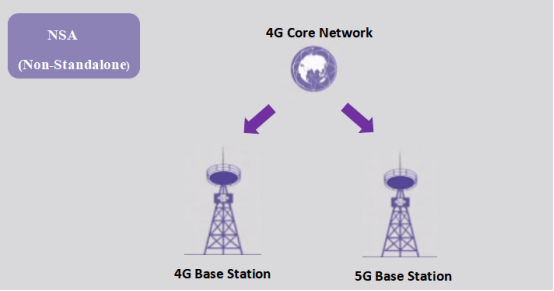
Advantages of NSA: rapid deployment (reuses all existing 4G infrastructure), immediate coverage (relies on the thousands of LTE sites already in place), low initial cost. This is why all French operators started in NSA in 2020–2021.
Limitations of NSA: high latency (inherited from the 4G EPC core, typically 15–30 ms), inability to enable network slicing, no access to advanced 5G features (URLLC, mMTC). The phone must also support 4G and 5G bands simultaneously, which impacts battery consumption.
SA architecture: native and standalone 5G
In SA mode, the terminal connects directly to the native 5G core network (5G Core / 5GC), without any dependence on the 4G network. The 5GC architecture is fundamentally different from the EPC core: it is entirely based on microservices and uses REST API interfaces for communication between network functions (NFs — Network Functions).
The main network functions of the 5GC:
- AMF (Access and Mobility Management Function) — manages access and mobility
- SMF (Session Management Function) — manages data sessions
- UPF (User Plane Function) — processes and routes user traffic
- PCF (Policy Control Function) — manages QoS policies and billing
- NSSF (Network Slice Selection Function) — selects network slices
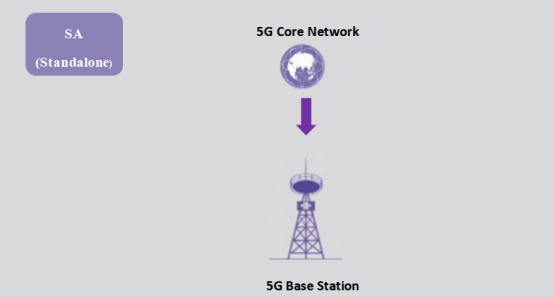
Advantages of SA: ultra-low latency (1–5 ms theoretical), network slicing (division of the network into virtual slices dedicated by use case), full support for URLLC use cases (industrial control, remote surgery, autonomous vehicles) and mMTC (massive IoT). Battery consumption is also reduced — only one active radio instead of two in NSA.
Constraints of SA: requires full deployment of a native 5G core, sufficient 5G NR coverage (no transparent 4G fallback), and SA-compatible terminal equipment — which excludes part of the 5G installed base from before 2022.
SA vs NSA comparison table
| Criterion | 5G NSA | 5G SA |
|---|---|---|
| Core network | 4G EPC (legacy) | Native 5GC |
| 3GPP option | Option 3x (EN-DC) | Option 2 |
| 4G dependency | Yes (mandatory) | No |
| Typical latency | 15–30 ms | 1–10 ms |
| Max downlink throughput | ~2 Gbps (aggregation) | ~10 Gbps (theoretical) |
| Network slicing | Not available | Yes (NSSF) |
| URLLC (critical low latency) | No | Yes |
| mMTC (massive IoT) | Limited | Yes |
| Terminal compatibility | Wide (all 5G) | Requires SA support |
| Terminal battery | High impact (2 radios) | Reduced impact (1 radio) |
| Operator deployment | Fast and less expensive | Long and more expensive |
| France coverage 2026 | 90 %+ of the population | Active deployment |
Performance: latency, throughput and network slicing
Latency — this is the most impactful difference for critical applications. In NSA, signaling goes through the 4G EPC core, which introduces an incompressible latency of 15 to 30 ms. In SA, the 5GC processes signaling locally (edge computing possible), making it possible to achieve latencies of 1 to 5 ms under optimal conditions. For most consumer use cases (streaming, gaming), this difference is imperceptible. It becomes decisive for industrial robotics, connected vehicles and real-time augmented reality.
Throughput — in practice, SA mode does not necessarily offer higher throughput than NSA under current field conditions. 5G throughput depends primarily on the frequency band used (3.5 GHz mid-band vs mmWave) and the density of cells. SA improves spectral efficiency and QoS management, but the actual throughput gap between SA and NSA remains small for an individual user.
Network slicing — this is the feature that really sets 5G SA apart for professional use cases. The physical network can be divided into isolated virtual slices, each with its own guarantees of throughput, latency and security. An operator can thus offer on the same physical infrastructure: a low-consumption IoT slice for industrial sensors, a URLLC slice for a surgical robot, and an eMBB slice for 4K video streaming — without interference between them. This capability is strictly absent from NSA mode.
5G deployment in France: where do operators stand?
In France, the four national operators all launched 5G NSA between November 2020 and mid-2021. Migration to SA is underway, with different timelines depending on the players:
- Orange — 5G SA deployment ongoing since 2023, initially in major metropolitan areas (Paris, Lyon, Marseille). The operator is aiming for progressive national SA coverage by 2027.
- SFR — announcement of SA deployment in 2024–2025, with an initial focus on industrial zones and enterprise use cases (private 5G network).
- Bouygues Telecom — progressive SA migration, with priority given to high-density sites and enterprise partnerships for network slicing.
- Free Mobile — SA deployment integrated into its network strategy, with the advantage of having a more recent 4G network to migrate.
In 2026, the majority of 5G plans in France remain marketed on the NSA network. 5G SA is mainly available through enterprise offerings (private 5G network, dedicated slicing) or in dense areas covered as a priority by operators.
For a consumer user, the practical difference between NSA and SA remains limited today. 5G SA comes into its own for B2B deployments: connected factories, logistics warehouses, autonomous ports, where guaranteed latency and slicing are contractual requirements.
Fiber and fronthaul: the infrastructure behind 5G
Whether SA or NSA, 5G relies heavily on optical fiber for its infrastructure links. The 5G radio network is broken down into three functional segments, each requiring very high-throughput, very low-latency fiber links:
- Fronthaul — link between the radio antennas (RRU/AAU) and the baseband processing unit (DU). Requires throughputs of 25 to 100 Gbps and a latency below 100 µs. Mainly uses dedicated point-to-point fiber links or XGS-PON networks.
- Midhaul — link between distributed units (DUs) and centralized units (CUs). Latency < 1 ms, throughput 10–25 Gbps depending on the number of aggregated cells.
- Backhaul — link between the CU and the core network (5GC or EPC). Can use long-haul OS2 fiber or microwave radio links for sites that are difficult to access.
SFP+ 10G and 25G modules are used in active radio equipment (AAU, DU) for short-distance fronthaul links. Singlemode OS2 fiber cables provide transport on the mid and backhaul segments.
-
Promo !
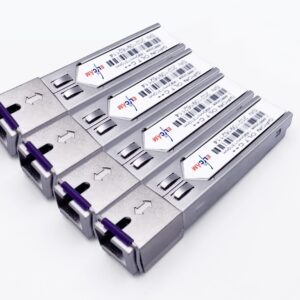
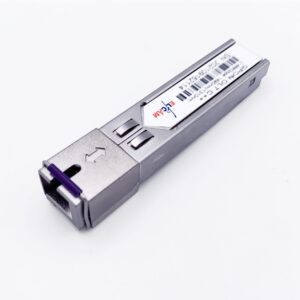
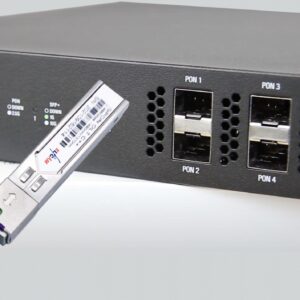
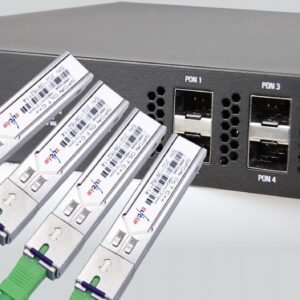
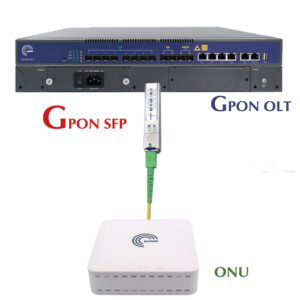
GPON OLT 2.5Gbps SFP Class C++ TX1490nm / RX1310nm 20km Transceiver, 20KM SC/UPC Optical Transceiver (Ref: 6631)
4 comments Lot 1 – Lot 4 Le prix initial était : 79,99 €.71,99 €Le prix actuel est : 71,99 €. + Ce produit a plusieurs variations. Les options peuvent être choisies sur la page du produit -
Promo !
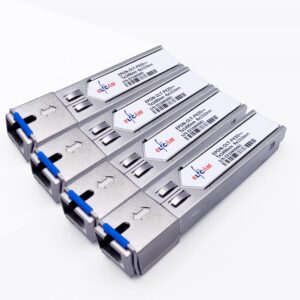
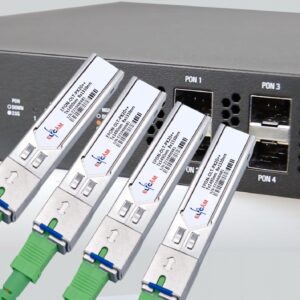
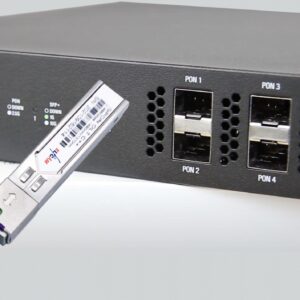
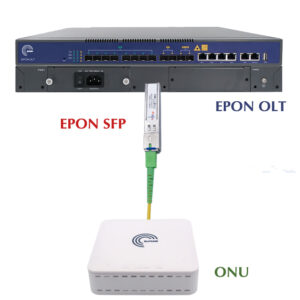
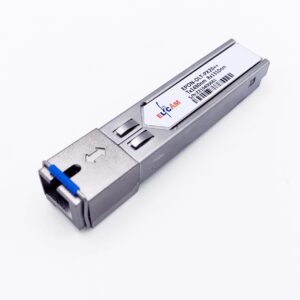
1.25G GPON EPON PX20++ SFP OLT Transceiver, TX1490nm / RX1310nm 20km, SC/UPC Optical Transceiver (Ref:6681)
3 comments Lot 1 – Lot 4 Le prix initial était : 79,99 €.71,99 €Le prix actuel est : 71,99 €. + Ce produit a plusieurs variations. Les options peuvent être choisies sur la page du produit -
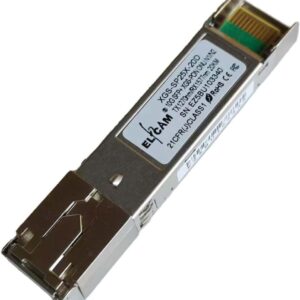
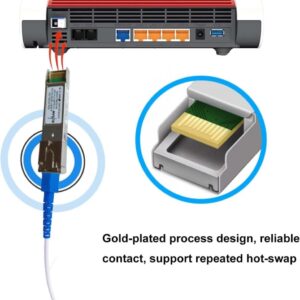
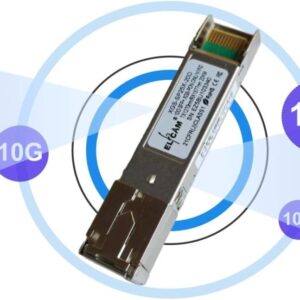
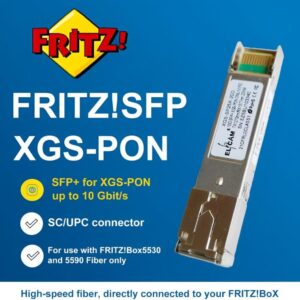
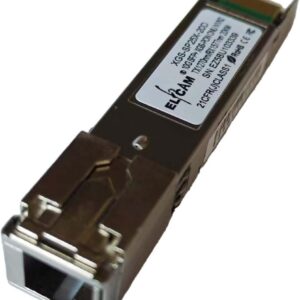
10G SFP+ Optical XGS-PON Module for 10GbE ONU, Up to 10 Gbit/s, Compatible with Fritz!Box 5530 Fiber and Fritz!Box 5590 Fiber
3 comments 49,99 € +
For deployments of private 5G networks in enterprise or campus, passive fiber infrastructure (OS2 cables, PLC splitters, XGS-PON OLT) constitutes the backbone on which 5G radio equipment relies. A well-dimensioned GPON or XGS-PON network can simultaneously serve 5G fronthaul and the site's FTTH services.
-
Promo !
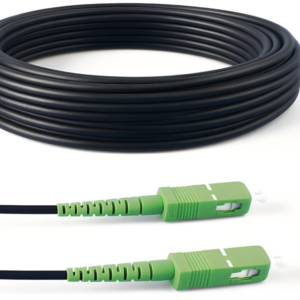
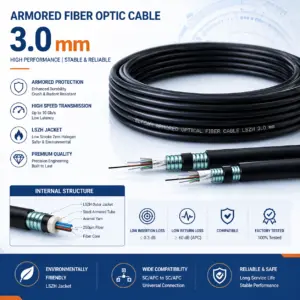
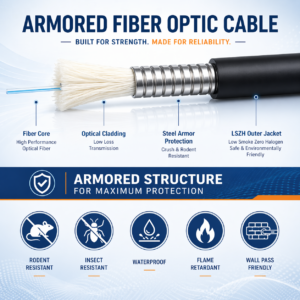
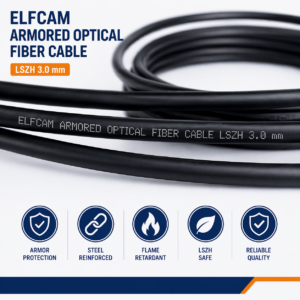

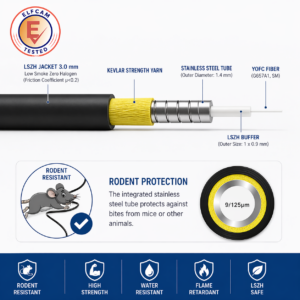
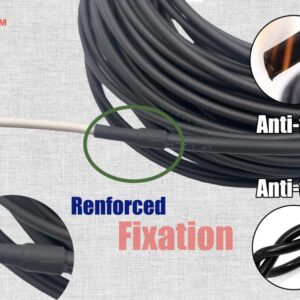
Câble fibre optique blindé acier SC/APC–SC/APC OS2 monomode simplex LSZH (Ref:1366)
74 comments 5M – 300M Le prix initial était : 9,90 €.7,48 €Le prix actuel est : 7,48 €. + Ce produit a plusieurs variations. Les options peuvent être choisies sur la page du produit -
Promo !

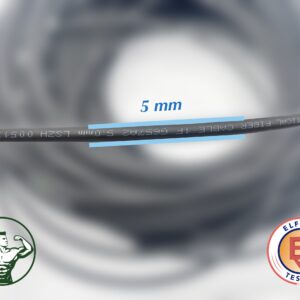
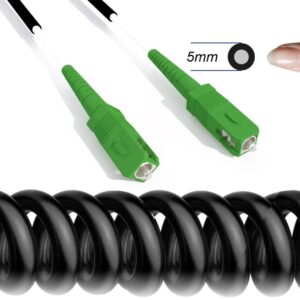
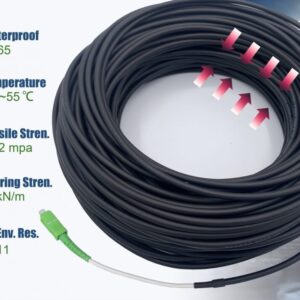
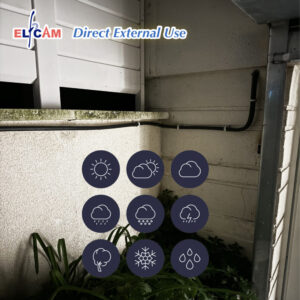
Câble à Fibre Optique Monomode SC/APC à SC/APC Renforcé pour Usage d’Extérieur et Intérieur(Ref:442)
31 comments 10M – 1000M Le prix initial était : 19,99 €.17,99 €Le prix actuel est : 17,99 €. + Ce produit a plusieurs variations. Les options peuvent être choisies sur la page du produit -
Promo !
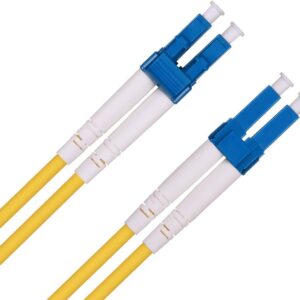

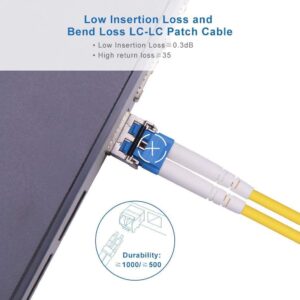
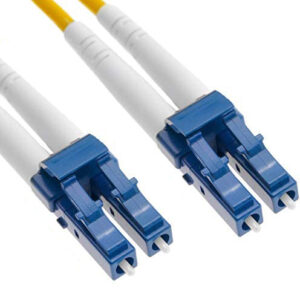
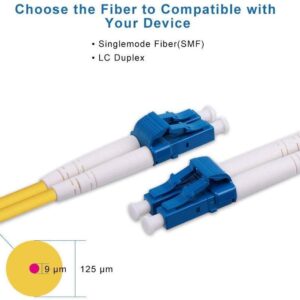
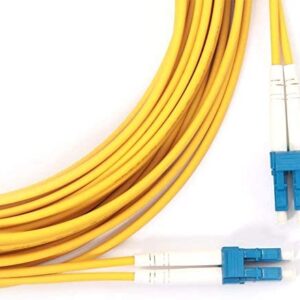

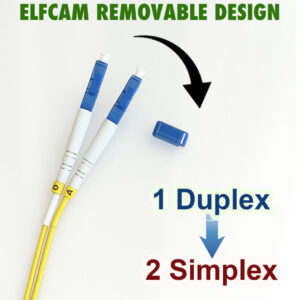
Câble à Fibre Optique LC/UPC á LC/UPC OS2 Duplex(Ref:425)
25 comments 0.5M – 50M Le prix initial était : 6,99 €.6,99 €Le prix actuel est : 6,99 €. + Ce produit a plusieurs variations. Les options peuvent être choisies sur la page du produit