Fiber optics vs copper cable: 8 decisive advantages and limits to know
Contents
We often hear that "fiber is better than copper" — without anyone explaining why or in which cases. Throughput, latency, distance, immunity to electrical disturbances, physical security, service life: each advantage has a precise physical basis. This guide sets out the 8 decisive technical advantages of fiber optics over copper cable, with real figures, and honestly presents the cases where copper remains more suitable.
1. Throughput and distance: the gap is abyssal
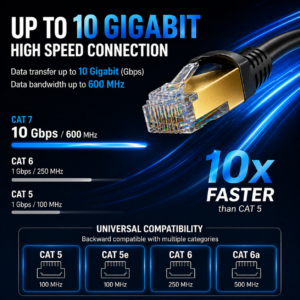
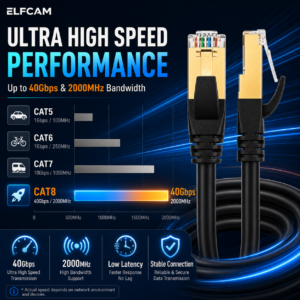
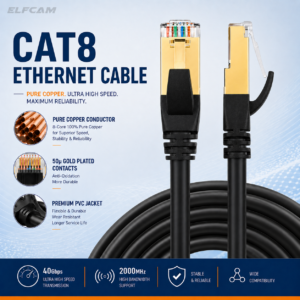
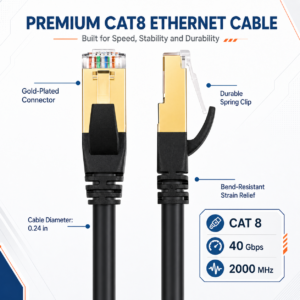
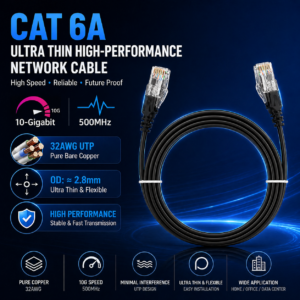
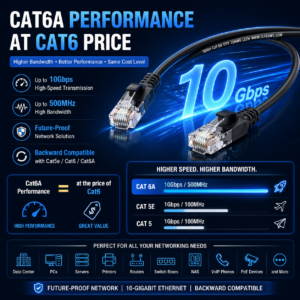
This is the best-known advantage, but the real figures are surprising. A copper Cat8 cable reaches 40 Gbit/s — but only over 30 metres maximum. Beyond that, throughput drops sharply: 10 Gbit/s over 55 m (Cat6A), 1 Gbit/s over 100 m (Cat6). Copper exceeds 100 m of usable range whatever the cable category.
Fiber optics does not have these distance constraints:
- Multimode OM4: 10 Gbit/s over 400 m, 100 Gbit/s over 150 m
- Single-mode OS2 + LR module: 10 Gbit/s over 10 km
- Single-mode OS2 + ZR module: 10 Gbit/s over 80 km
- Single-mode OS2 + DWDM + EDFA: 100× 100 Gbit/s (10 Tbit/s) over thousands of kilometres
The physical reason: in a copper cable, the electrical signal undergoes exponential attenuation with frequency (skin effect, resistance, parasitic capacitance). In fiber optics, the light signal is subject to very low, near-linear attenuation (0.2 dB/km at 1550 nm) with no dependence on throughput within the current limits of equipment.
At 10 Gbit/s, OS2 single-mode fiber carries the signal over 10,000 m where Cat6A stops at 55 m — i.e. 180× farther.
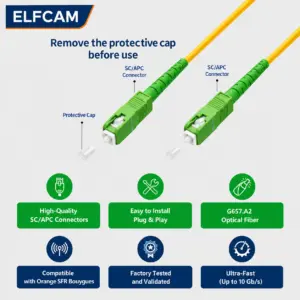
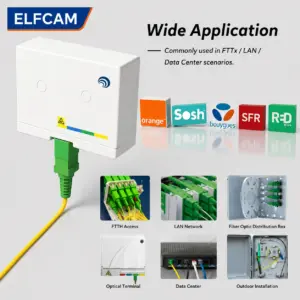
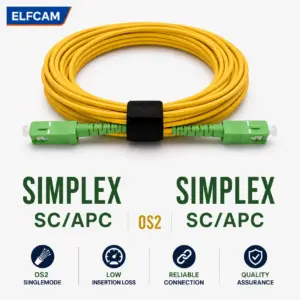
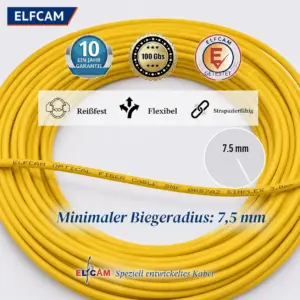
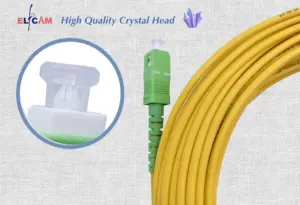
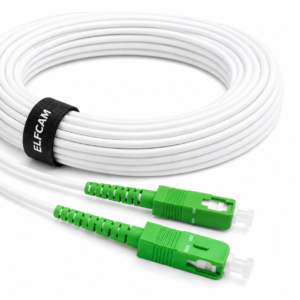
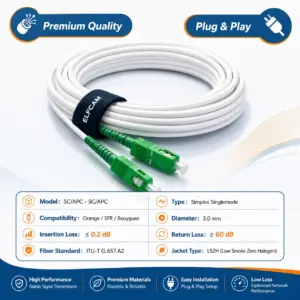
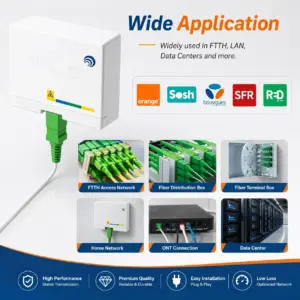
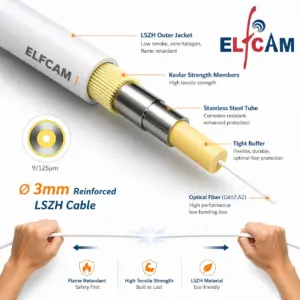
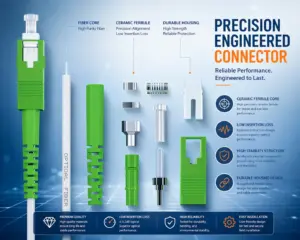
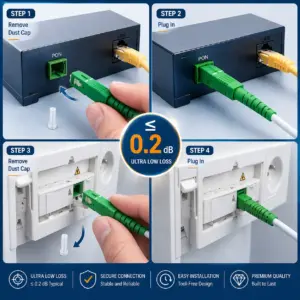
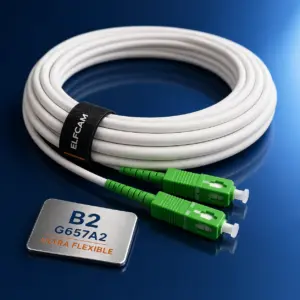
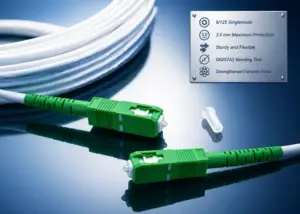
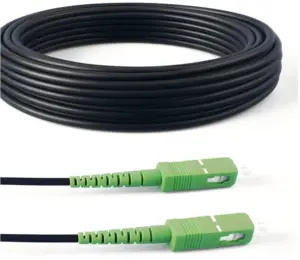
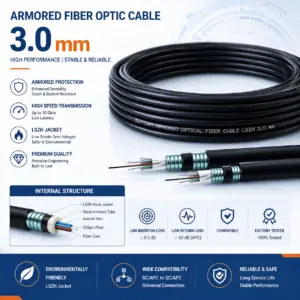
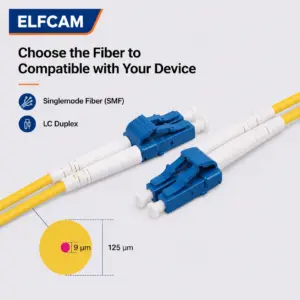
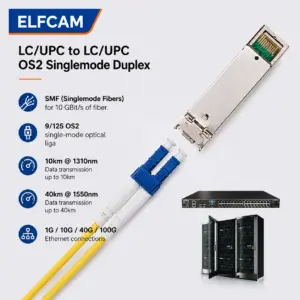
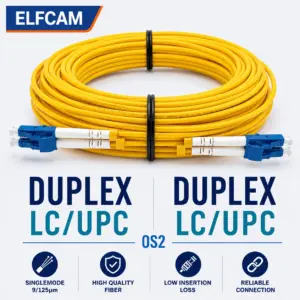
Elfcam single-mode fiber optic cables
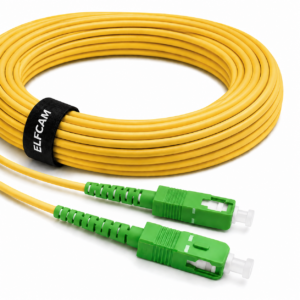
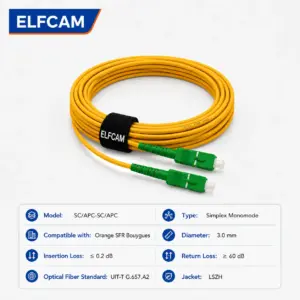
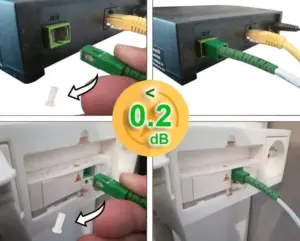
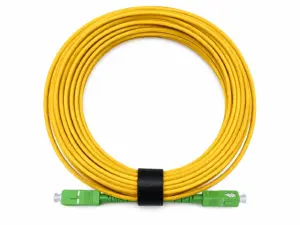
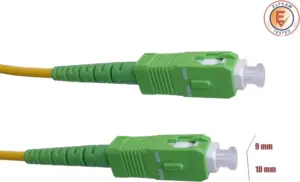
- SC/APC–SC/APC OS2 patch cords — FTTH, campus links, rack to rack
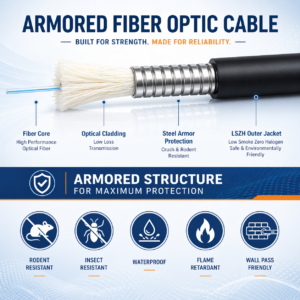
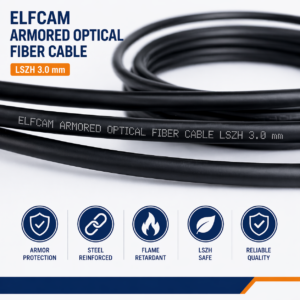
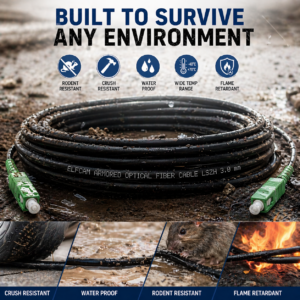
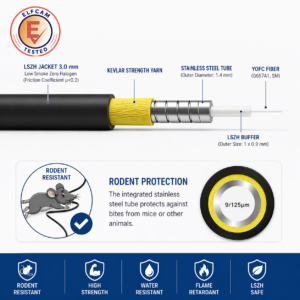
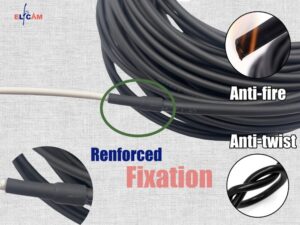
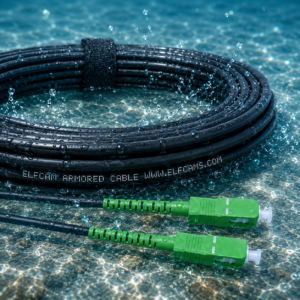
- Steel-armoured OS2 cables — outdoor inter-building with no range limit
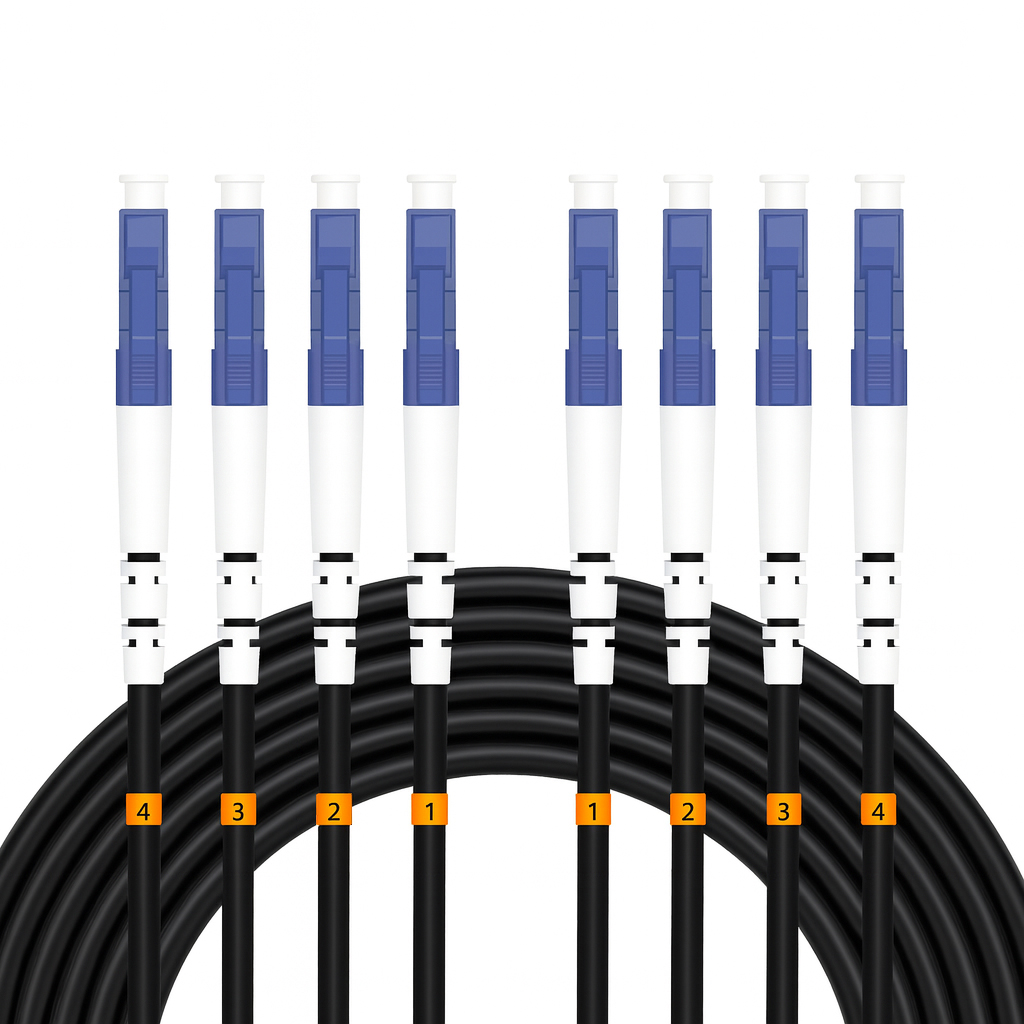
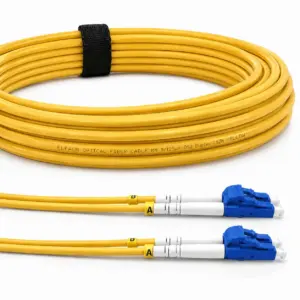
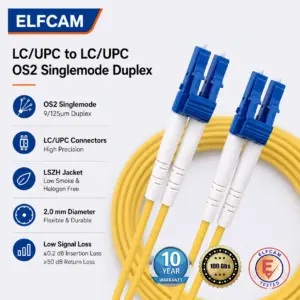
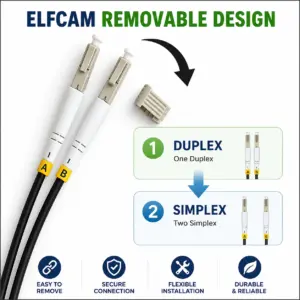
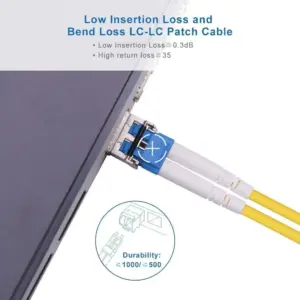
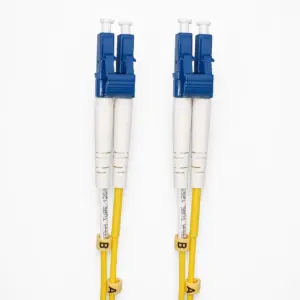
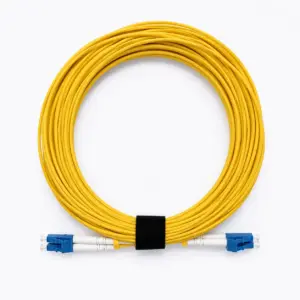
- LC/UPC–LC/UPC OS2 duplex patch cords — switches and SFP equipment

2. Immunity to electromagnetic interference
A copper cable is an electrical conductor: it behaves like an antenna and picks up the surrounding electromagnetic fields — electric motors, frequency inverters, transformers, ballast lighting, high-voltage lines, radio equipment. These disturbances induce parasitic voltages in the signal, degrading transmission quality and increasing the error rate.
Fiber optics does not conduct electricity. An electromagnetic field, however intense, cannot create induction in a silica fiber. The fiber can therefore be laid:
- In industrial cable trays alongside 400 V power cables without specific shielding
- Near motors, pumps, inverters (major sources of disturbance)
- In hospitals (MRI, scanners) where magnetic fields are intense
- Outdoors with no risk of coupling with neighbouring HV lines
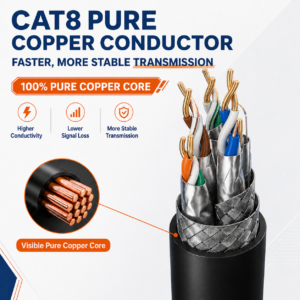
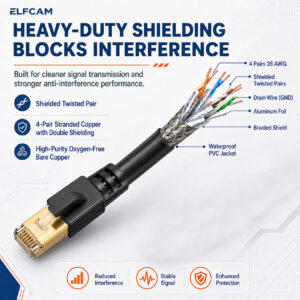
To achieve comparable performance in copper in these environments, you have to use S/FTP cables (double shielding) or high-frequency twisted cables — and manage grounding issues, ground loops and currents induced on the shields.
3. Electrical isolation and inter-building safety
This is an often underestimated advantage. When two buildings are connected by a copper Ethernet cable, they share an electrical ground reference. If the buildings have different ground potentials (a frequent situation in industrial settings or with old electrical installations), a current flows in the cable shield. This current can damage the connected network equipment, create dangerous overvoltages, and in extreme cases cause fires.
Fiber optics is a perfect electrical insulator: no current flows between the two ends, even with a potential difference of several hundred volts. It can also be used in ATEX zones (explosive atmospheres) where any electrical spark is prohibited.
Furthermore, in the event of a lightning strike on a building, the overvoltage propagates instantly across any interconnected copper network and can destroy the equipment of neighbouring buildings. With fiber, this propagation is impossible.
4. Light weight and reduced bulk
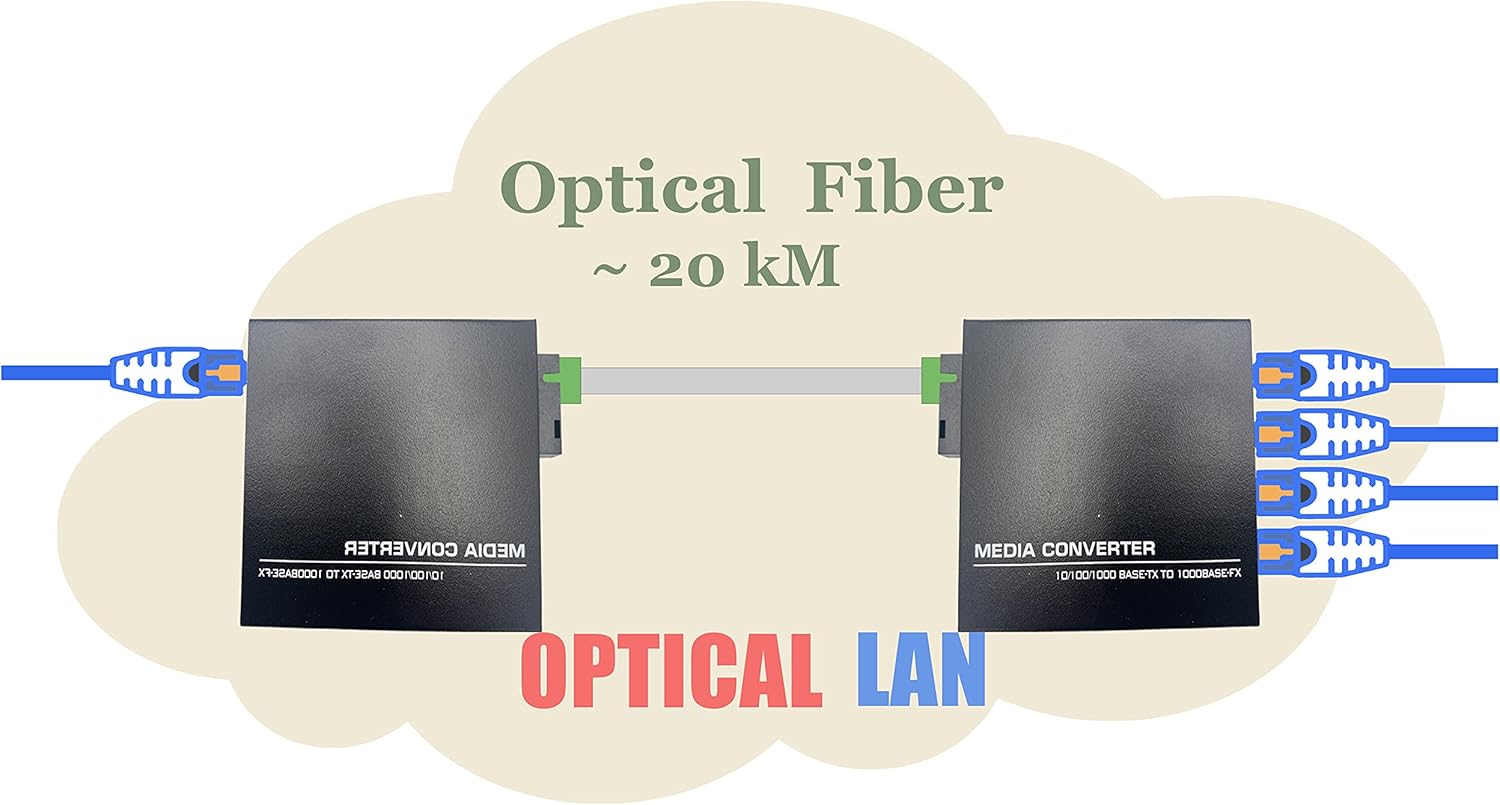
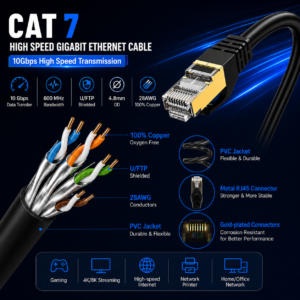
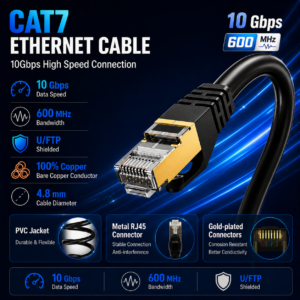
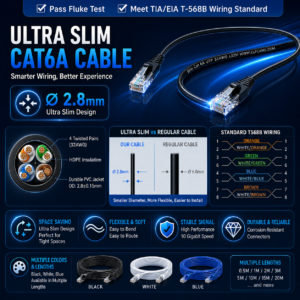
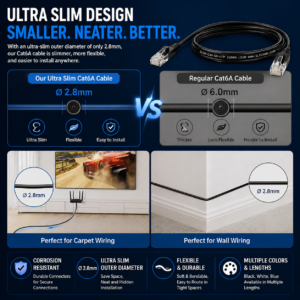
An OS2 duplex fiber optic cable has a diameter of 2.0 mm and weighs around 5 g/m. An equivalent copper Cat7 cable is 6.5 to 8 mm in diameter and weighs 45 to 60 g/m. At comparable throughput, fiber is 10 to 12× lighter and 3× less bulky.
This difference is decisive for:
- Cable trays in datacenters: with hundreds of links, the load per linear metre on the cable trays drops significantly
- Existing conduits: in renovation, it is often possible to run several fibers where a single copper cable would fit
- Aerial links (between buildings on self-supporting cable): weight is critical for long spans
- Transparent/discreet cables: 0.9 mm G.657B3 fiber cables can be fixed along skirting boards practically invisibly
5. Transmission security
A copper cable radiates a measurable electromagnetic field around it. With specialised equipment (TEMPEST attack), it is possible to intercept the transmitted data without physical contact with the cable. This vulnerability is particularly concerning in sensitive environments (defence, finance, healthcare).
Fiber optics does not radiate an electromagnetic signal. All the light is confined within the 9 µm core. The only theoretical way to intercept data on a fiber is to bend the cable to create a detectable optical leak (macrobend) — a physical manipulation that requires direct access to the cable and that causes a measurable loss on the link, detectable by OTDR monitoring.
For installations in shared buildings, co-located datacenters or links crossing public areas, fiber therefore offers a significantly higher level of physical security than copper.
6. Service life and resistance over time
Silica does not oxidise. A copper cable sees its electrical resistance increase slightly with the oxidation of the conductors and RJ45 contacts, and its PVC sheath degrades under UV outdoors in 5 to 7 years. A fiber optic cable with a PE/HDPE sheath resists UV for 20 to 25 years without degradation of transmission performance.
The FTTH distribution cables installed today in conduit are designed for 25 to 40 years of service per ITU-T L.35. Over the same period, a copper network generally requires at least one migration to a higher category (from Cat5 to Cat6 to Cat6A to Cat8) to keep pace with the evolution of throughput — each migration involving a complete new cable pull.
Fiber is also a future-proof infrastructure
An OS2 cable installed today in conduit can carry 1 Gbit/s, 10 Gbit/s or 100 Gbit/s depending on the active modules plugged in at the ends — without changing the cable. Going from 1G to 10G means replacing the SFP modules, not the passive cabling. The same Cat6 copper cable cannot be "upgraded" beyond its physical frequency limits.
Fiber optics vs copper cable comparison table
| Criterion | OS2 fiber optics | Cat6A copper | Cat8 copper |
|---|---|---|---|
| Max throughput | 400 Gbit/s+ (QSFP-DD) | 10 Gbit/s | 40 Gbit/s |
| Max distance at max throughput | 10 km (10G LR) | 55 m (10G) | 30 m (40G) |
| Max distance 1 Gbit/s | > 100 km | 100 m | 100 m |
| Cable diameter | 2 mm (duplex) | 6.5 mm | 7–8 mm |
| Weight | ~5 g/m | ~45 g/m | ~55 g/m |
| EMI immunity | Total (no conductor) | Partial (S/FTP shielding) | Partial (S/FTP shielding) |
| Electrical isolation | Complete (inter-building safe) | None (ground loop risk) | None |
| Physical security | High (no EMI radiation) | Low (interceptable radiation) | Low |
| Service life | 25–40 years | 15–20 years | 15–20 years |
| Upgrade without re-pulling | Yes (change active modules) | No (limited by frequency) | No |
| Cable cost | Low | Moderate | High |
| Active equipment cost | Higher (SFP modules) | Low (integrated RJ45 port) | Moderate |
| PoE possible | No (no conductor) | Yes (up to 90 W PoE++) | Yes |
Real limits of fiber optics
Technical honesty requires mentioning the cases where copper remains relevant or preferable:
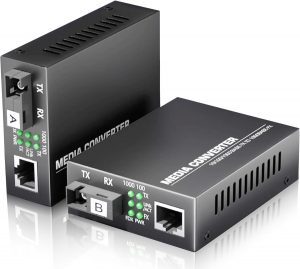
PoE (Power over Ethernet) is impossible on fiber. Fiber does not conduct electricity, so it cannot power remote equipment (IP cameras, WiFi access points, IP phones) the way PoE does over copper cable. In this case, you must either use a copper cable for the PoE equipment, or deploy a local power supply + a fiber for the data.
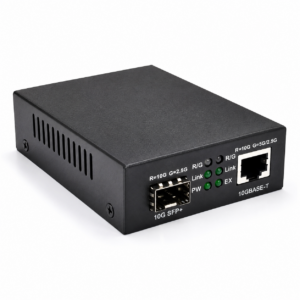
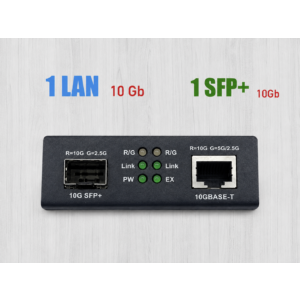
The installation cost is higher. SFP/SFP+ modules for active equipment (switches, routers) represent an extra cost compared with integrated RJ45 ports. For a small home network or an office with 4 to 8 workstations over short distances, a Gigabit RJ45 switch is less expensive to install than a complete fiber infrastructure.
Fiber connectors require care. A 1 µm dust particle on an SC/APC connector can seriously degrade the link. Fiber connectors must be cleaned before each connection and protected by caps when not in use. RJ45 connectors are far more tolerant of dusty environments.
Repair in case of a break requires a fusion splice. Repairing a severed copper cable can be done with a junction connector. A cut fiber requires a fusion splicer (equipment from €1,500 to €10,000) or replacement of the cable.
Practical rule: fiber or copper?
Choose fiber if the distance exceeds 100 m, if the environment is electrically disturbed, if the link crosses several buildings, or if you are aiming for a throughput > 10 Gbit/s over more than 55 m. Keep copper for workstations (short distances + PoE), small home networks and equipment without an SFP port.
1Is fiber optics always better than copper Ethernet cable?
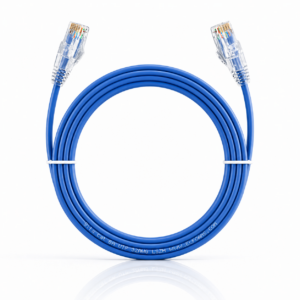
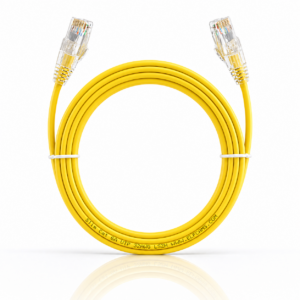
For long distances (more than 100 m), electromagnetically disturbed environments, inter-building links and throughputs above 10 Gbit/s over more than 55 m: yes, fiber is objectively superior. For short distances (< 50 m) with PoE equipment, a small home network or a standard workstation, copper Ethernet cable remains simpler and cheaper to install. The right choice depends on the use case, not on an absolute rule.
2Can you do PoE (Power over Ethernet) with fiber optics?
Not directly. Fiber optics is a pure electrical insulator — it cannot carry current. To power remote equipment via fiber, the alternative solutions are: local power at the equipment + a fiber link for the data, or PoE over fiber injectors (special devices that inject PoE onto the Ethernet data upstream of the fiber converter). These devices are more complex and costly than a direct PoE cable.
3Is fiber optics really faster than copper Ethernet?
Light in a fiber optic cable travels at about 200,000 km/s (2/3 of the speed in a vacuum), versus ~200,000 km/s as well for the electrical signal in copper — the propagation latency is therefore comparable at equal distance. On the other hand, fiber supports much higher throughputs over much greater distances thanks to the absence of modal dispersion (single-mode) and very low attenuation. The "speed" of fiber comes from its throughput and distances, not from an intrinsically higher propagation speed.
4Can a fiber optic communication be tapped the way a copper cable can?
It is technically much more difficult. Fiber does not radiate any electromagnetic signal that can be intercepted at a distance. The only known eavesdropping method requires direct physical access to the cable and bending the fiber sharply to create an optical leak — a manipulation that causes a measurable loss (0.1 to several dB) on the link, immediately detectable by a real-time OTDR monitoring system. In secure installations (defence, finance), this monitoring is standard.
5Why use fiber between two buildings and not Ethernet cable?
Three main reasons: distance (Ethernet cable is limited to 100 m, fiber covers kilometres); electrical isolation (two buildings often have different ground potentials — a copper cable creates a ground loop that can damage equipment or create an overvoltage during a lightning strike); lightning resistance (fiber does not conduct overvoltages between buildings, unlike copper). Electrical regulations moreover require an optical link or suitable surge protection for copper inter-building links.
6Can fiber optics be laid next to electrical power cables?
Yes, with no particular restriction. Fiber optics is totally immune to the electromagnetic fields of power cables, even MV. No specific shielding is required, and no regulatory separation distance applies to fiber cables (unlike copper data cables, which must be separated from power cables according to NF C 15-100). This advantage is particularly valuable in industrial installations and mixed cable trays.
7Is a fiber optic cable more fragile than an Ethernet cable?
Bare silica fiber is indeed mechanically more fragile than a copper conductor. But commercial fiber cables are built with aramid reinforcements, protective tubes and robust sheaths that make them comparable to Ethernet cables in terms of everyday resistance. Steel-armoured outdoor cables are more resistant than any Ethernet cable. The real fragility of fiber is at the connector level (optical face sensitive to dust) rather than the cable itself.
8What are the delivery times for Elfcam fiber and Ethernet cables?
OS2 fiber patch cords (SC/APC, LC/UPC), reinforced outdoor cables and Cat6A/Cat7/Cat8 Ethernet cables from Elfcam are all available in stock in France with shipping within 24 working hours. Orders placed before 2:00 pm are shipped the same day. For structured cabling projects with large volumes, professional quotes with scheduled delivery are available on request.